Michelangelo David TicketsTickets & Tours
Florence · History & visitor context

Michelangelo David Gallery History & Visitor Information

Michelangelo David Gallery is more than one statue. It is the Galleria dell’Accademia di Firenze, shaped by academies, collections, and a purpose-built room for David. This page shows the main dates, the changes that made the museum, and the details that help you read the galleries faster.

Named afterGalleria dell’Accademia di Firenze
Founded1784, with roots in 1563
The famous phase and its yearsDavid’s Tribuna, 1882
Original functionAcademy and museum complex
Origins

Why the Accademia exists, and why David later changed its meaning

The building began as an academy setting, not as a single-work shrine. That is why the museum still mixes sculpture, paintings, casts, and instruments around David.

01 1563–1784

From artist academy to museum complex

Cosimo I de’ Medici founded the Accademia delle Arti del Disegno in 1563. Pietro Leopoldo reorganised the institution in 1784, and the museum grew around the old San Matteo hospital and the San Niccolò di Cafaggio convent.

Why this matters The museum was never built for only one object. Its plan still reflects a working academy and a wider collection.
02 1784–1882

The first collections filled the academy spaces

The museum expanded after church and convent suppressions in 1786 and 1810. It absorbed paintings, sculpture, plaster casts, and later the musical instruments collection, so the galleries became a teaching and display route rather than a single hall.

Visitor takeaway David is the climax, but the museum’s earlier rooms explain how Florence used art for study, display, and memory.
!
The common mistake: this is not a separate “Michelangelo David museum”

The original Michelangelo David is inside the Galleria dell’Accademia. The name on the building matters, because the surrounding rooms and collections are part of the visit, not extra material.

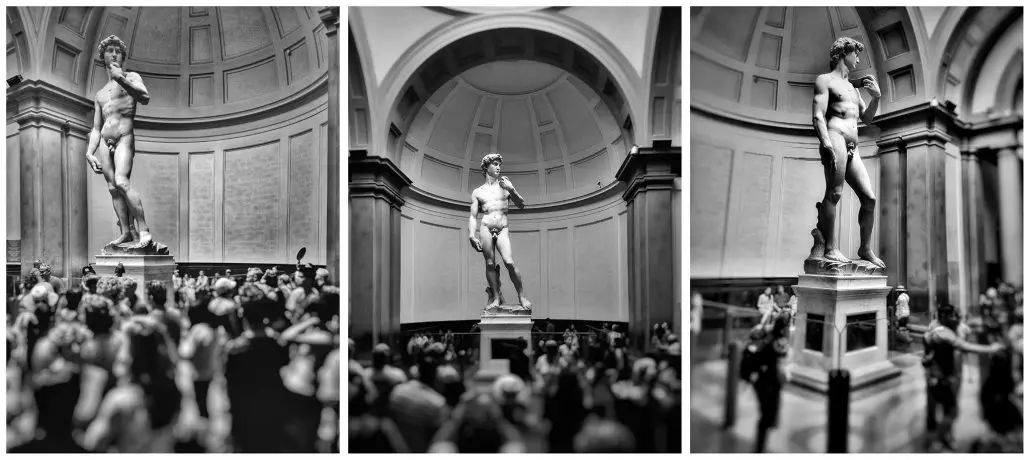
The marble statue of David standing in a gallery, with visitors nearby
David is framed by a room designed for him. The Tribuna opened in 1882 after the statue moved indoors in 1873. The space turns the sculpture into a final reveal after the long gallery of unfinished works.
How it changed

The stages that created the museum you walk through today

The Galleria dell’Accademia is not one project. It is a chain of academy decisions, collections, and museum changes, with David arriving last and changing the route around him.

01 1563

Cosimo I founded the drawing academy

The Accademia delle Arti del Disegno began under Cosimo I de’ Medici. That gave Florence a place to train artists and gave later museum rooms a scholarly base long before David arrived.

What remains The museum still feels organised for study as much as for display.
02 1784

Pietro Leopoldo reshaped the institution

Grand Duke Pietro Leopoldo reorganised the academy in 1784. He turned older spaces and holdings into a more modern institutional complex, which is why the museum still combines teaching roots with exhibition rooms.

What to notice The collection feels assembled, not architecturally fixed around one masterpiece.
03 1786 and 1810

Suppressed churches and convents fed the collection

Works entered state holdings after the suppression of churches and convents in 1786 and again in 1810. That is why the museum holds many paintings and plaster works alongside Michelangelo’s sculptures.

Important distinction Much of what looks like a “fine arts gallery” came from later collecting, not one original commission.
04 1873

David moved indoors for preservation

The original David left Piazza della Signoria in August 1873 and moved to the Accademia. Florence was protecting the marble, and the museum then had to create a new room for it.

Visitor takeaway The statue you see indoors is the original marble, not a copy.
05 1882

The Tribuna opened around David

Emilio De Fabris designed the Tribuna, and the space opened to the public with David in 1882. The room changed the museum route, because the long approach now leads toward one exact reveal.

What remains The final room still works like a stage built to frame one sculpture.
06 1909

The Prisoners were moved from Boboli Gardens

The four unfinished Prisoners had stood in the Buontalenti Grotto in Boboli Gardens. They were moved to the Accademia in 1909, which let the museum turn Michelangelo’s process into part of the main route.

What to notice The rough figures now build the journey to David, instead of sitting apart as curiosities.
07 2001–2026

The museum added instruments and new visitor rules

The Musical Instruments section opened in 2001. In 2026, the museum added updated regulations across the GAMB system, which tightened the rules for bags, water, photography, and visitor conduct.

Visitor takeaway The museum now reads as a wider collection with stricter protection, not a loose storage of masterpieces.
Technique

David was carved from a difficult block

Michelangelo worked on a marble block already begun by Agostino di Duccio and Antonio Rossellino. The finished statue still shows how hard it was to free the figure from the stone.

Money

Patronage shaped the whole story

The academy, the later museum, and the Tribuna all grew from public decisions and civic money. David’s move indoors was also a decision about preservation, not only taste.

Meaning

The route turns process into meaning

The Prisoners, the paintings, and David are arranged as a sequence. You learn to read finish, restraint, and display before you reach the famous body in the centre.

Five dates worth remembering before you visit

You do not need every patron name in your head. These five moments explain how the museum became what you see now.

  1. 1563: Cosimo I founded the Accademia delle Arti del Disegno, giving Florence an artist academy that later shaped the museum.
  2. 1784: Pietro Leopoldo reorganised the institution and set the modern museum structure in motion.
  3. 1501–1504: Michelangelo carved David, the work that later became the museum’s centrepiece.
  4. 1873: The original David moved indoors from Piazza della Signoria to protect it.
  5. 1882: The Tribuna opened, and the statue gained its purpose-built setting.
Architecture & meaning

How the museum works, and why the layout matters

The original function explains the form. The museum still behaves like a sequence of rooms made for study, collection, and reveal.

How the building works

A route, not a single hall

The museum uses linked rooms and galleries, with David in the Tribuna at the end of a long approach. The original academy and the later museum grew across older religious buildings, so the structure feels layered and practical.

  • The long Gallery of the Prisoners leads toward David.
  • The Tribuna gives the statue a central, clear view.
  • Older rooms still hold paintings, casts, and instruments.
Why the imagery matters

David is the climax, not the whole story

The museum sequence teaches you to see Michelangelo as part of a larger Florentine world. The unfinished Prisoners, the painted panels, and the finished statue each say something different about skill, control, and civic pride.

  • The rough marble makes finish look deliberate.
  • The gallery order builds expectation before the statue appears.
  • The collection is a museum route, not a UNESCO-listed monument.

Two things people misread

First, many visitors treat David as if the museum exists only for one sculpture. The route proves the opposite. The museum makes you pass unfinished figures, older paintings, and instrument rooms before the final room.

Second, people often mix up the original marble with the outdoor copies. The original is inside the Accademia. The outdoor David in Piazza della Signoria is a later copy, and the one at Piazzale Michelangelo is bronze.

Why the room around David matters

The Tribuna is part of the work you see. Emilio De Fabris did not just make a display room. He created a setting that changes how you read the statue’s scale, posture, and isolation.

What to notice

The details that make the visit clearer

The museum can feel full at first glance. A short list helps more than trying to read every room at once.

1. The long approach to David

The Prisoners corridor is not filler. It sets up the final room, so David arrives as the answer to the route you just walked.

2. The unfinished marble

The Prisoners show chisel marks and rough stone. That is the best way to see the difference between a work in progress and the finished body nearby.

3. The central setting in the Tribuna

The room was built for David. Its purpose is visible the moment you stand inside and see how the statue holds the centre.

4. The older rooms before the sculpture climax

Paintings and casts come first for a reason. They show how the academy grew into a museum before David became its most famous room.

5. The copies outside Florence

Knowing the original is indoors changes the walk through the city. The outdoor figures become echoes, not replacements.

6. The mixed collection

Michelangelo is central, but not alone. The museum’s paintings and instruments explain why the Accademia still matters beyond one statue.

Ready to visit

Look at it as layers of history, not one famous room

Start with the academy roots, then follow the corridor of unfinished works, and only then enter the Tribuna. That order makes David easier to read, because you see how Florence built meaning around the statue before you stand in front of it.