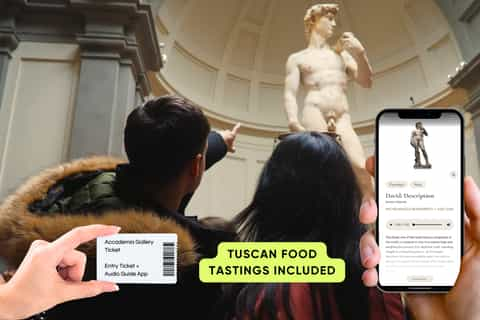
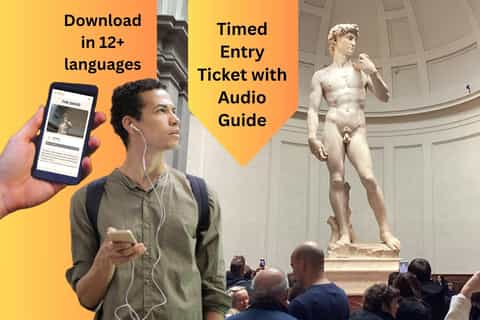
Florence: Timed Entry to Michelangelo’s David + Audio App
A strong first choice for visitors who want timed entry and extra context on the phone. It suits a short Florence stop and keeps the visit simple.
Book Michelangelo David Gallery tickets and guided tours for 2026. Compare timed entry, audio guides, and guided visits, then choose the option that fits your visit, budget, and time in Florence.
A strong first choice for visitors who want timed entry and extra context on the phone. It suits a short Florence stop and keeps the visit simple.
This site is independent and not the official website of the attraction or operator. Some links are affiliate links, and we may earn a commission at no extra cost to you. We help you compare ticket type, access, and tour format for Michelangelo David Gallery visits.
Compare six options in descending review order. Check ticket type, access areas, guided versus independent visits, visit length, traveller feedback, and the current starting price before you book.
1
Most reviewed
★★★★★ 4.56 · 21,525 reviews
It has the most reviews among these six options. Choose it if you want timed entry with extra context on your phone and a simple self-guided visit.
2
Timed entry
★★★★★ 4.50 · 15,402 reviews
This timed entry ticket has fewer reviews than the option above, but it keeps the visit direct. Compare it if you want a straightforward ticket without adding an audio app.
3
Low price
★★★★★ 4.41 · 7,720 reviews
Start here if your budget leads the decision: this has the lowest supplied starting price among these six. Its title suggests broader museum access, so check the selected option before comparing it with priority tickets.
4
Guided tour
★★★★★ 4.76 · 4,559 reviews
This guided option has fewer reviews than the top three but the strongest rating in this set. Choose it if you want timed entry plus a guide for the museum rooms and David.
5
Audio guide
★★★★★ 4.55 · 4,233 reviews
The lower starting price distinguishes this from the other timed-entry ticket shown. It suits visitors who want an audio guide rather than a guided tour, while keeping the visit on their own pace.
6
Fast-track
★★★★★ 4.57 · 2,993 reviews
This fast-track ticket has fewer reviews than the other entry options shown and a higher starting price than the budget ticket above. Compare the booking details if you want priority access without a guided visit.
These six options differ by ticket type, access, and how much help you want on site. Some keep things simple with timed entry, while others add an audio app, guide, or broader museum access.
| Option | From | Rating | Reviews | Ticket type | Includes | Best for |
|---|---|---|---|---|---|---|
| Florence: Timed Entry to Michelangelo’s David + Audio AppTimed entry with phone-based context for a self-guided visit. | €29 | 4.5552173 | 21,525 | Timed entry | Audio app · Independent visit | Travellers who want the most reviewed option with extra context on their phone. |
| Florence: Michelangelo’s David Official Timed Entry TicketStraight timed entry for a direct museum visit without extra add-ons. | €42 | 4.4994817 | 15,402 | Official ticket | Timed entry · Independent visit | Visitors who want a simple entry ticket and do not need an audio app. |
| Florence David & Accademia ALL Collections Ticket & Audio AppBroader museum access with an audio app and the lowest starting price. | €5 | 4.414285 | 7,720 | Combined ticket | All collections · Audio app | Travellers focused on price who want more than David alone. |
| Florence: Accademia Gallery David Guided Tour & Timed EntryGuided museum visit with timed entry and the strongest traveller rating here. | €44 | 4.75696 | 4,559 | Guided tour | Guided visit · Timed entry | Visitors who want a guide and more context in the museum rooms. |
| Florence: Timed Entry to Michelangelo’s David & Audio GuideTimed admission paired with an audio guide at a lower starting price. | €20 | 4.5479007 | 4,233 | Audio guide | Timed entry · Audio guide | Travellers who want self-paced visiting with listening support instead of a live guide. |
| Florence: Accademia Gallery & David Fast-track TicketPriority-style entry for visitors who want a faster museum start. | €43 | 4.5711355 | 2,993 | Fast-track ticket | Entry ticket · Independent visit | Visitors who want quicker entry and prefer to explore on their own. |
Answer four quick questions to narrow the six options. They differ by ticket type, access level, visit style, and what other travellers value most.
We will show the closest match once all four answers are chosen.
Until then, compare the products shown above and use the questions to narrow down your visit style.
Tickets here can look similar while covering different access, timing, and support. Check the details before you pay, so you know where to go, what is included, and what the visit will actually feel like.
Your ticket may not cover the full Accademia visit
Some options focus on timed entry for David, while others add audio support or broader collections. If you assume every ticket covers the same rooms, you may miss parts of the museum you wanted to see.
Fix: Check the inclusions line for the exact option you choose. Look for words like timed entry, audio app, audio guide, guided tour, or collections ticket before you pay. If you want David plus more of the museum, confirm that the ticket says so clearly.
Skip-the-line still leaves the security queue
Reserved entry helps with ticket access, but it does not remove museum screening. If you arrive at the last minute, the security step can eat into your visit time even when your slot is valid.
Fix: Treat the booked time as the start of your entry process, not a bypass. Check the voucher for the meeting or entry time, then plan to reach the entrance early enough to clear metal-detector screening before your slot closes.
Large bags can be refused at the entrance
The museum does not have a cloakroom. Luggage, big backpacks, helmets, and other bulky items over 40 × 30 × 18 cm are not allowed, so the wrong bag can stop you before you enter.
Fix: Check your bag before you leave. If it is large, store it elsewhere first. Keep only a small day bag with you, and avoid bringing anything that may be classed as bulky or unsafe.
Some items and habits are not allowed inside
Current rules limit photography gear, drinks, food, animals, smoking, and phone use. If you expect to carry water, take flash photos, or visit with a pet, you may need to change plans on arrival.
Fix: Review the rules for water, photos, and visitor conduct before you go. Bring only a small plastic water bottle if needed, leave flash and selfie sticks at home, and check whether anyone in your group needs an approved service animal arrangement.
This section covers the practical details that matter after you have chosen a ticket. Check the opening times, last entry, bag rules, accessibility, and the limits that can change your visit.
The Galleria dell’Accademia opens Tuesday to Sunday from 08:15 to 18:50, with last admission at 18:10.
Closing procedures begin at 18:40, so the visit ends before the published closing time. The museum is closed on Mondays, 1 January, and 25 December.
One current official page shows a later 18:20 cut-off for last admission and ticket office closing. Use the museum’s own current visitor page if you want the stricter time.
Free-entry days are busy and reservations are not active. On those dates, visitors queue at the entrance.
This matters most if you are fitting David into a short Florence day. A late arrival can lose your chance to enter even when the doors are still open.
Most visitors allow about 1 to 1.5 hours for David and the main museum rooms.
The museum does not set one official visit length. That time is a practical plan for a focused visit that covers David, the Prisoners, and a few other highlights.
If you want more time for paintings, the Musical Instruments rooms, or the plaster casts, allow 1.5 to 2+ hours instead.
Arriving close to last admission shortens the visit even if you get in. The museum starts clearing before closing, so late entry leaves less time for the galleries.
That is why a timed booking helps. It protects your entry time, but it does not create extra visiting time after the cut-off.
A standard Accademia ticket gives museum admission, and Michelangelo’s David is inside the museum route.
There is no separate official David-only ticket. The museum ticket covers the route where David stands in the Tribuna, together with the other permanent collections.
The museum also holds Michelangelo’s Prisoners, St. Matthew, paintings, plaster casts, and the Musical Instruments section. Some combined tickets add the Bargello or other museums, but those are separate products.
Do not assume every ticket includes the same rooms. Product names such as audio app, audio guide, guided tour, and collections ticket point to different inclusions.
This matters because the wrong ticket can leave out the part you wanted to see most. Read the inclusions line before you book.
The main address is Via Ricasoli 58/60, and the accessible entrance and ticket office are at Via Ricasoli 60.
Use the exact museum address when you navigate: Via Ricasoli 58/60, 50122 Firenze. That is the destination visitors should search for, not just “Michelangelo David”.
The accessible entrance is separate at No. 60. That is useful for wheelchair users and for anyone needing the step-free entry point and ticket office.
The museum sits in Florence’s historic centre near the Duomo and San Marco area. Walking is usually the simplest approach from the cathedral area.
That distinction matters because the wrong side of the building can waste time, especially if your entry slot is close to last admission.
Large luggage, big backpacks, helmets, and bulky items over 40 × 30 × 18 cm are not allowed, and the museum has no cloakroom.
That bag limit is one of the most important rules for this museum. If your bag is too large, you may be stopped before entry.
The museum also references an external luggage-storage service near the site, but that is not a cloakroom inside the museum.
Non-folding umbrellas must stay in the designated umbrella holders near the entrance. That makes a small day bag the safest choice.
This matters because a suitcase or oversized backpack can ruin a timed slot. Store it first, then arrive with only what you can carry through security.
All visitors pass metal-detector screening, and reserved or skip-the-line entry does not bypass it.
Security screening is part of every visit. Even with a timed ticket, you still need time for the metal detectors before you enter the route.
Children under 12 must be with an adult. Phones must be on silent or switched off, and visitors must not sit on floors or stairs.
Touching works, crossing barriers, or placing objects close enough to risk damage is not allowed. Dangerous objects are also prohibited.
That is why the booked slot should be treated as entry time, not as a guarantee of instant access. Build in a little margin before your slot ends.
Personal handheld photos are generally allowed, but flash, selfie sticks, and bulky tripods are prohibited.
The current rules also prohibit drones. Professional photography or video may need museum permission.
Food is not allowed through the visitor route. Water is allowed only in a plastic bottle up to 0.5 litres. Glass bottles and cans are not permitted.
Smoking and vaping are prohibited. That keeps the route more controlled, but it also means you should finish snacks and drinks before you enter.
If you want photos of David, a phone or small camera is the safe option. Do not plan on a tripod or flash setup inside.
Yes, the museum has an accessible entrance, lifts, first-floor stairlifts, wheelchair loans, and priority access for eligible disabled visitors.
Accessible entry is at Via Ricasoli 60. The main rooms, including the Hall of the Colossus, the Gallery of the Prisoners, David’s Tribuna, the plaster-cast gallery, and the Musical Instruments rooms, are described as wheelchair accessible.
A lift reaches the first floor, and stairlifts help with movement between some rooms. The museum also says standard wheelchairs may be needed to use the first-floor stairlifts.
Wheelchairs can be requested free of charge, subject to availability. An accessible toilet is available on the ground floor near the lift and bookshop area.
That makes the museum workable for many visitors with reduced mobility, but not every route detail is identical. The accessible entrance and route matter more than the main front door.
The museum has two bookshops, an audioguide service, baby-changing facilities, and toilets reached at the end of the visitor route.
The audioguide costs €6, and you must leave an original ID document to get it. That is useful if you want extra context without joining a guided tour.
Toilets are only accessible at the end of the visitor route. The museum also says baby-changing facilities are available.
There is no verified official museum café in the fact sheet, so do not plan a snack stop inside. Treat food as something to finish before entry.
That matters because the route is more focused than many visitors expect. It helps to know where the toilets are before you start.
Start with David, then the Gallery of the Prisoners, St. Matthew, and the Hall of the Colossus.
The Tribuna with David is the centrepiece, but the walk there is part of the visit. The long Gallery of the Prisoners leads directly toward the statue.
Other strong stops include Giambologna’s large model for the Rape of the Sabine Women, the medieval gold-ground paintings, and the Musical Instruments section.
If you enjoy sculpture, the unfinished Prisoners show Michelangelo’s chisel work and rough marble surfaces very clearly. That gives the museum more depth than a quick David-only stop.
This matters for planning because the best route through the museum is not random. The David room is the climax, not the only thing worth your time.
Most visitors come for one statue and leave without reading the room around it. Michelangelo’s David matters because the Galleria dell’Accademia turns the sculpture into a sequence: unfinished figures, painted panels, then the finished body in the Tribuna. The museum helps you understand David as the centre of a larger story about Florence, ambition, and artistic process.
Read the museum as a path toward David, not a single stop around him.
David began as a cathedral project, then became a civic image. That shift is the key to the sculpture’s power in Florence. It was made for a religious setting, yet later stood beside Palazzo Vecchio, where it came to suggest the city’s strength and independence.
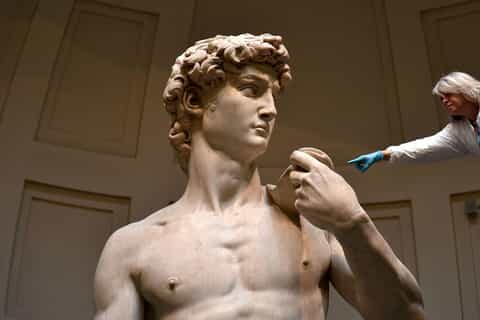
Look at the pose with that history in mind. The oversized hand, the tense head turn, and the prepared sling all read differently once you know the figure was meant to carry public meaning, not just biblical narrative.
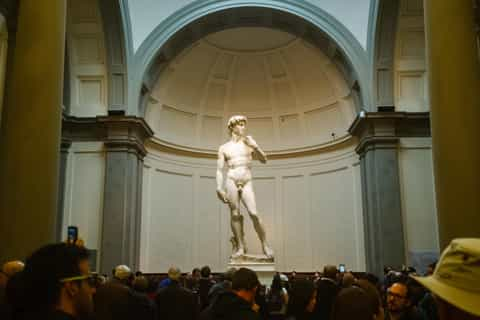
The Tribuna is not a neutral display room. It was designed for David, and the statue still feels framed by purpose rather than surrounded by museum clutter. That is why the final approach through the long gallery matters so much: the room builds expectation before the sculpture appears fully in view.
The experience works best when you notice distance and placement. David stands centrally, so the space around him does half the interpretive work.
The Prisoners change the tone of the visit. Their rough surfaces, chisel marks, and half-emerged figures show Michelangelo working against the block instead of simply polishing a finished form. They also remind you that David was not meant to stand alone as a masterpiece in isolation.
St. Matthew strengthens that reading. Together, these works show Michelangelo as an artist interested in tension, not just finish. The museum lets you see different stages of release from stone, which makes David feel less like a single object and more like the final point in a creative process.
Start with the large hall, then follow the Prisoners toward the Tribuna. After David, slow down again for the paintings and the Musical Instruments rooms. That order shows how the Accademia balances sculpture, painting, and collection history instead of treating David as a standalone stop.
Once you notice that structure, the visit changes. You stop seeing the Accademia as “the place with David” and start reading it as a museum built to explain how Florence made art, used art, and turned art into memory.
Booking is not compulsory, but the Accademia strongly recommends reserving a timed ticket. Without a reservation, you may face a long queue, particularly on busy days.
The museum says that same-day tickets may be available at its ticket office even when online slots are sold out. If your Florence schedule is tight, reserve ahead rather than relying on walk-in availability.
The official standard Accademia admission price is €20, effective from February 2026. The eligible reduced ticket is €2 for EU citizens aged 18–24, with certain other nationalities and categories also qualifying.
Reserved entry may have a €4 booking fee. Guided tours and third-party packages can cost more, so compare the final price and exactly what is included.
No. The original David is displayed inside the Galleria dell’Accademia, and standard museum admission includes it alongside the other museum collections.
There is no separate official David-only admission ticket. If a listing advertises David access, check whether it is ordinary museum entry, a reserved ticket, an audio experience, or a guided tour.
A timed-entry ticket reserves an entry time, after which you explore the museum independently. A guided tour adds a guide who explains David, Michelangelo’s unfinished sculptures and selected gallery rooms.
Guided tours do not all include admission in the advertised price. Read the inclusions and meeting-point instructions carefully before paying.
No. A reserved or priority ticket may reduce the ticket-entry wait, but everyone must still pass the museum’s required security screening.
Arrive at the time stated on your voucher and leave a little margin for checks. No legitimate ticket should promise that security can be bypassed.
Go to the Galleria dell’Accademia at Via Ricasoli 58/60 in central Florence. The museum’s accessible entrance and ticket office are at number 60.
If you booked through a tour provider, your meeting point may be outside the museum rather than at the entrance itself. Follow the address on your booking confirmation.
Late admission is not guaranteed. Reserved tickets and tours are linked to specified entry or meeting times, and individual providers may set their own late-arrival rules.
Check your voucher before travelling and contact your booking provider immediately if you are delayed. Do not assume the museum will honour a missed slot.
Allow around 60–90 minutes for David, the Gallery of the Prisoners and other highlights. If you enjoy Renaissance paintings, sculpture and the Musical Instruments collection, allow closer to two hours.
This is a practical estimate, not a fixed museum tour length. A guided tour may cover selected rooms only; check whether you can remain afterwards.
The museum’s published ordinary hours are Tuesday to Sunday, 8:15 am to 6:50 pm. It normally closes on Mondays, 1 January and 25 December, apart from announced special openings.
Its official visitor page currently lists last admission at 6:10 pm, while some other published information says 6:20 pm. For a relaxed visit, book well before either cutoff and confirm the current schedule.
Yes. The Accademia offers free admission on the first Sunday of each month and on certain additional announced dates. On these days, reservations are not available.
You must queue for admission, and waiting times can be long. Free admission does not mean a reserved skip-the-line place or a free guided tour.
Visitors under 18 qualify for free museum admission, but proof of age or eligibility may be requested. Children under 12 must be accompanied by an adult.
The €2 reduction is subject to specific eligibility rules and valid identification. Check whether a booking or guide fee still applies to children on third-party tours.
Only small personal bags are allowed. The museum does not have a cloakroom, and luggage, bulky backpacks, helmets and items larger than 40 × 30 × 18 cm are prohibited.
Store larger bags elsewhere before arriving. This is especially important if you are coming directly from the airport or train station.
Personal photography is generally allowed, but flash photography and equipment such as selfie sticks or tripods are restricted under the museum’s visitor rules.
Keep your phone or camera handheld, follow staff instructions and do not touch artworks or cross barriers. Photography rules may differ for special exhibitions.
Yes. The museum identifies an accessible entrance at Via Ricasoli 60 and accessible access to the principal rooms, including the Tribuna of David. An accessible toilet and mobility facilities are provided.
Visitors with certified disabilities and eligible accompanying persons may qualify for free and priority entry. Bring appropriate documentation and contact the museum if you need specific assistance.
Standard Accademia admission does not include the Uffizi Gallery. The museum also sells a separate 48-hour Accademia + Bargello ticket for €26 and a 72-hour multi-museum ticket for €38.
If you want to visit several museums, compare the combined ticket with separate tickets and check which locations are included. Do not assume a Michelangelo’s David tour includes other Florence museums.
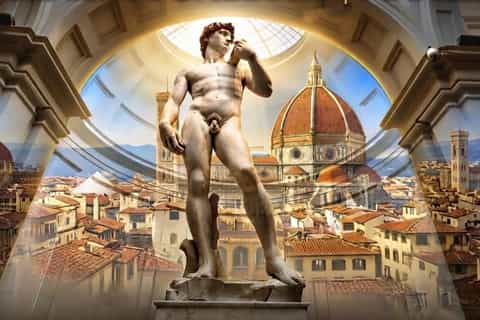
Each of these is its own guide, with its own opening hours, ticket comparison and route notes. The David stands in the Accademia, a few streets north of the cathedral: the Duomo is ten minutes south, the Uffizi and Palazzo Vecchio fifteen, and Pitti is over the river.
Each of these guides is run by the same editorial team and checks its facts against official sources. We do not sell tickets: bookings go through the booking partner, and a booking may earn us a commission at no extra cost to you.